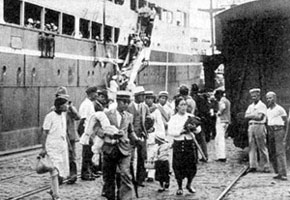
June 18, 1908. On this day, the first ship carrying Japanese immigrants to work on the country’s coffee plantations docked at the port of Santos. On this ship, 781 people arrived. They would be the first of many. But, in fact, the first Japanese to set foot on Brazilian soil were four crew members of a Japanese ship that was shipwrecked on the Japanese coast. Yes, on the Japanese coast. The ship was called the Wakamiya Maru, and they were rescued by a Russian vessel. This ship could not deviate from its route, so the four Japanese men made the entire journey. On December 20, 1803, the ship docked for repairs in what is now the city of Florianópolis. The ship would only set sail to continue its voyage on February 4, and during this interval, the Japanese made notes about the country and the agriculture practiced in the South American nation.
Returning to traditional immigration, although the first Japanese only arrived in the country to live in 1908, the legal procedures began a few years earlier. In 1880, conversations began for the countries to sign a treaty, the “Treaty of Friendship, Commerce, and Navigation,” which would be signed in 1885. In 1892, Decree No. 97 was enacted, which dealt with the matter: “ALLOWS FREE ENTRY INTO THE TERRITORY OF THE REPUBLIC FOR IMMIGRANTS OF CHINESE AND JAPANESE NATIONALITY; AUTHORIZES THE GOVERNMENT TO PROMOTE THE EXECUTION OF THE TREATY OF 09/05/1890 WITH CHINA; TO CELEBRATE A TREATY OF COMMERCE, PEACE AND FRIENDSHIP WITH JAPAN, AND GIVES OTHER PROVISIONS CONCERNING IMMIGRATION FROM THOSE ORIGINS,” signed by Marshal Floriano Peixoto, the second Brazilian president after the fall of the Brazilian Empire.
In 1894, Japan sent a representative to visit Brazil, who recommended Brazil as a suitable country to receive Japanese immigrants. However, the drop in the value of coffee in global markets postponed the arrival of the workers. Thus, after the recovery of the coffee price, an agreement was signed between a Japanese businessman and politician, Ryu Mizuno, and the Secretary of Agriculture of São Paulo, Carlos Arruda Botelho. This agreement provided for a total of 3,000 Japanese immigrants.
Despite the difficult adaptation of the first immigrants to work on the coffee farms, this did not prevent the rapid increase in the number of immigrants – it is estimated that, in the state of São Paulo alone, there were 10,000 Japanese working in 1914. In 1932, according to data from the Consulate General of Japan in São Paulo, the Japanese population was 132,689, with the absolute majority dedicated to agriculture.
During the Second World War, the Brazilian government, allied with the American-British-French axis, enacted laws that directly affected the Japanese-Brazilian population. For example, all publications in the Japanese language were banned, and correspondence to and from Japan ceased to be delivered. This was especially impactful, as a 1939 survey indicated that 87.7% of this population subscribed to a Japanese-language newspaper.
Source: FAPESP
The tensions during the Second World War were so high that, in 1941, the Brazilian Minister of Justice, Francisco Campos, advocated for the prohibition of the entry of 400 Japanese, citing
“their despicable standard of living represents brutal competition with the country’s worker; their selfishness, their bad faith, their refractory character, make them an enormous ethnic and cultural cyst located in the richest regions of Brazil.”
After the war, the rules were slowly relaxed, and immigration resumed.
In 1958, data indicate that more than 404,000 Japanese and their descendants lived in Brazil. In that year, Mikasa, brother of the then Emperor Hirohito, visited the country for the fiftieth-anniversary celebrations of immigration. In 1967, Crown Prince Akihito, now Emperor, and Princess Michiko visited Brazil for the first time. At the reception for the imperial couple, the Japanese-Brazilian community filled a popular stadium in São Paulo, the Pacaembu stadium. In 1973, the Nippon Maru, the last ship to transport Japanese immigrants, arrived in Santos.
Currently, it is estimated that there are 2 million Japanese or their descendants, making Brazil the largest Japanese community outside of Japan. Of these, 46,000 are Japanese. The states with the largest number of Japanese-Brazilians are São Paulo and Paraná. A phenomenon that is currently occurring is the emigration of Brazilians to Japan in search of better work opportunities, known by the term “dekasseguis.” In 2023, the Brazilian community in Japan was composed of 211,840 people, making it the fourth-largest foreign community in the Asian country.
Notable Personalities
The Japanese-Brazilian community has produced several prominent figures in different fields:
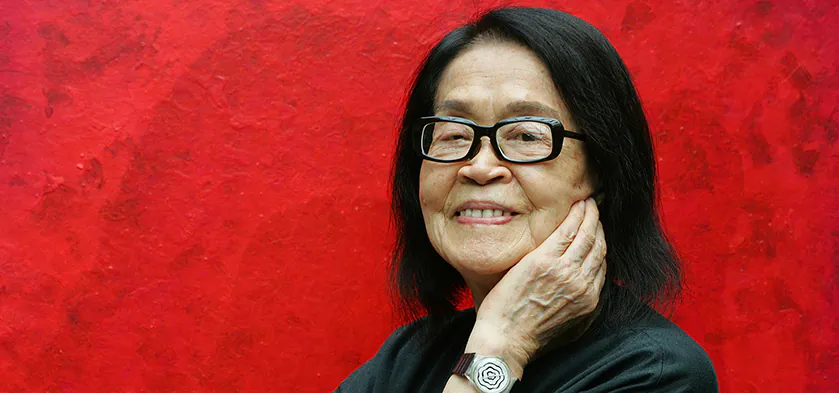
Tomie Ohtake (1913-2015) – One of the most important visual artists in Brazil, she arrived in the country in 1936. Her abstract work is internationally recognized, and the Tomie Ohtake Institute in São Paulo is named in her honor.
Source: Instituo Tomie Ohtake
Tikashi Fukushima (1920-2001) – A painter who became one of the leading names in contemporary Brazilian art, known for his landscapes that blend Eastern and Western techniques.
Lydia Yamamoto – The first Nisei (daughter of Japanese immigrants) woman to become a doctor in Brazil in the 1940s, when it was extremely rare for women to be in medicine.
Chieko Aoki – A businesswoman who founded the Blue Tree Hotels chain, becoming one of the leading entrepreneurs in the Brazilian hotel industry.
Saburo Okabe – A pioneer in mechanized agriculture in Brazil, he introduced Japanese techniques that revolutionized cultivation in various regions.
Oscar Matsuo – An agronomist who contributed significantly to the development of soybean cultivation in Brazil, helping to transform the country into a world leader in production.
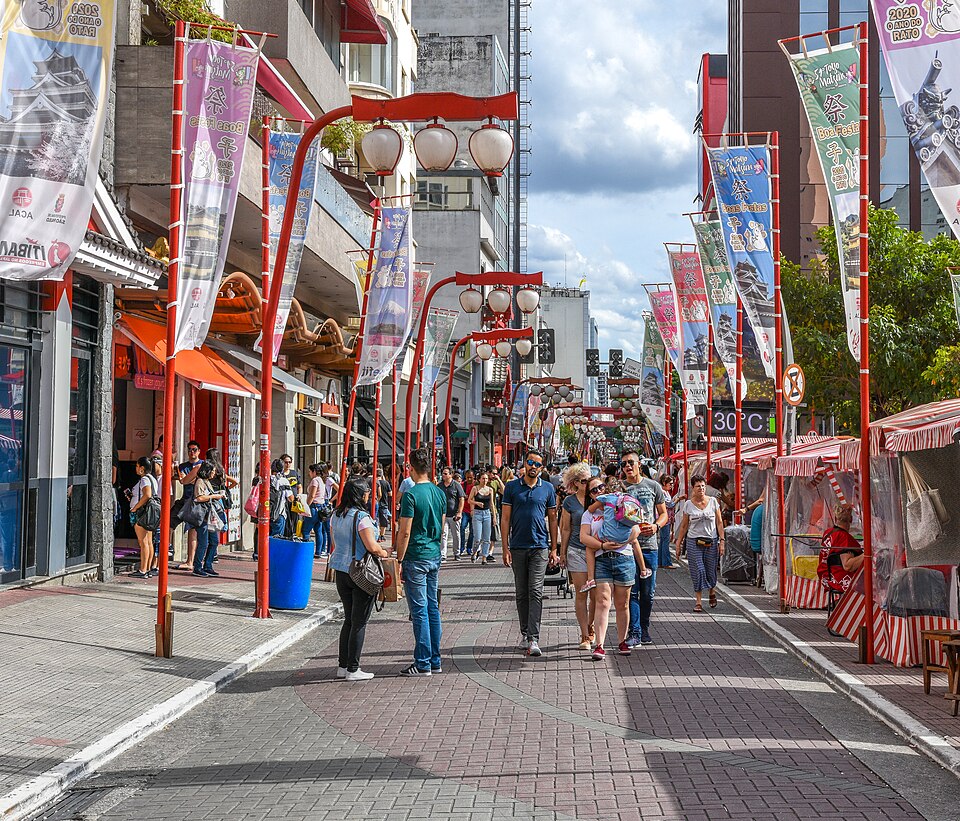
The Liberdade Neighborhood – São Paulo
The Liberdade neighborhood, in São Paulo, is the heart of the Japanese community in Brazil:
- Originally known as “Bairro dos Enforcados” (Neighborhood of the Hanged) for being a place of execution for slaves and convicts, it was renamed “Liberdade” (Freedom) after the proclamation of the Republic.
- Starting in the 1910s, it began to receive Japanese immigrants, who established small businesses and residences.
- In the 1970s, a revitalization project introduced typical elements of Japanese architecture: the suzurantō lanterns (red lanterns), the torii gates, and the oriental gardens.
- Praça da Liberdade (officially Praça Almeida Junior) became the cultural center of the neighborhood, where the traditional craft fair takes place on weekends.
- The Museum of Japanese Immigration, inaugurated in 1978, preserves the memory of the immigrants with documents, photographs, and historical objects.
- Traditional festivals such as the Tanabata Matsuri (Star Festival), the Hanamatsuri (Flower Festival), and the Mochi Tsuki Matsuri (Rice Cake Pounding Festival) are celebrated annually.
Japanese Presence in Maringá
Maringá, in the north of Paraná, has a strong Japanese influence:
- The city was founded by the Companhia de Terras Norte do Paraná in 1947 and soon attracted Japanese immigrants due to the fertility of the red soil, ideal for coffee cultivation.
- COCAMAR (Cooperativa Agroindustrial de Maringá), founded in 1963 with significant participation from Japanese-Brazilian farmers, became one of the most important agricultural cooperatives in Brazil.
- The Parque do Japão, inaugurated in 2009, is a 100,000 m² cultural complex that celebrates Japanese culture with gardens, lakes, a teahouse, and an immigration memorial.
- The Associação Cultural e Esportiva de Maringá (ACEMA) was founded in 1947 and keeps traditions such as undokai (sports gymkhana) and Japanese language classes alive.
- The diversified agriculture introduced by the Japanese transformed the regional economy, with emphasis on the production of vegetables, fruits, and soybeans.
Japanese Presence in Curitiba
Curitiba also has an expressive Japanese-Brazilian community:
- The first significant wave of Japanese immigrants arrived in Curitiba in the 1920s, settling mainly in the neighborhoods of Santa Felicidade and Uberaba.
- The Bosque do Jardim Japonês, inaugurated in 1962, is one of the city’s landmarks, with its traditional gate, teahouse, and typical architecture. It was expanded and revitalized in 1993.
- The Memorial da Imigração Japonesa, located in the Mercês neighborhood, preserves the community’s history with permanent exhibitions.
- The UNIOESTE (União Cultural e Esportiva Oeste do Paraná) plays a fundamental role in preserving Japanese traditions, offering cultural and sports activities.
- The Curitiba Japanese Culture Festival, held annually, attracts thousands of visitors with cultural presentations, gastronomy, and exhibitions.
- Urban and peri-urban agriculture in Curitiba was strongly influenced by Japanese techniques, especially in the cultivation of organic vegetables.
Cultural and Economic Legacy
The impact of Japanese immigration extends beyond these main centers:
- Introduction of agricultural crops: The Japanese were responsible for introducing or improving the cultivation of tea, jute, black pepper, melon, kiwi, and various vegetables in Brazil.
- Cooperativism: The model of agricultural cooperatives was strongly disseminated by Japanese immigrants, transforming productive organization in various regions.
- Education: The high value placed on education is a striking feature of the Japanese-Brazilian community, resulting in high levels of schooling among their descendants.
- Gastronomy: Dishes such as sushi, sashimi, temaki, and yakisoba have been incorporated into Brazilian cuisine, with local adaptations that have created a unique Japanese-Brazilian style.
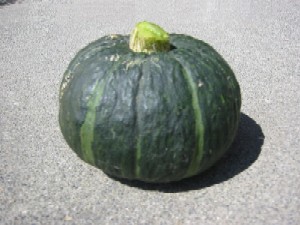
The image is from Cota – Kabocha.jpg (transferred by Eugene van der Pijll), Domínio público, https://commons.wikimedia.org/w/index.php?curid=782652
This rich cultural and economic heritage continues to flourish and renew itself, keeping the bridges between Brazil and Japan alive through the generations.