20 December 1930, Tapajós River, Pará. In the workers’ cafeteria of the strangest town in Brazil, an argument breaks out between a supervisor, Kaj Ostenfeld, and a brick mason, Manuel Caetano. Within hours it turns into a riot. Workers who are fed up with the brown rice, whole-wheat bread and canned peaches they’re made to eat smash the cafeteria, wreck the generators, cut the telegraph wires and chase the American managers into the jungle and onto boats in the river. Order comes back only after soldiers arrive. Locals remember the episode as the Quebra-Panelas, the “Breaking of the Pans.”
The town was called Fordlândia, “Ford-land.” It was one of the most ambitious, and most absurd, experiments of the 20th century: an attempt by the richest industrialist in the world to grow his own rubber, and to rebuild small-town America on the banks of an Amazon river.
Why Would Henry Ford Want the Amazon?
The short answer is tires. Every Model A rolled out of Dearborn on rubber, and by the 1920s most of the world’s rubber came from British and Dutch plantations in Asia, grown from seeds smuggled out of Brazil decades earlier. When Britain moved to control prices, an idea associated with Winston Churchill and the so-called “rubber cartel,” Ford decided he would rather own the source.
There was some historical irony in this. The Amazon had been the centre of the rubber boom around 1900. Belém became Brazil’s busiest port, and Manaus built its famous opera house, the Teatro Amazonas, on latex money. Then the Asian plantations undercut wild Brazilian rubber, and the region’s economy collapsed. When Ford arrived, the local papers treated him as a saviour. Some writers guessed he would build railroads or car factories.
Ford had bigger ambitions than rubber. As Greg Grandin shows in his history of the town, Ford saw the project as a “work of civilisation.” In 1928 he declared: “We are not going to South America to make money, but to help develop that wonderful and fertile land.” His industrial capitalism was changing the American small town he loved. In the Amazon he could try to rebuild it from scratch.
The Deal
Ford negotiated with the state of Pará and got a concession of roughly 10,000 km² (about 2.5 million acres, an area the size of a small US state) on the east bank of the Tapajós, around 300 km south of Santarém. Under the terms, Ford paid no taxes on exports. In return, 9% of profits would go to Brazil: 7% to the government and 2% to local municipalities.
Ford also got a bad deal and didn’t know it. According to Grandin, his agents paid about $125,000 for land he could have had almost for free. And nobody seems to have asked whether the site was actually good for rubber. The land turned out to be hilly, rocky and poor.
A Prefabricated Midwest
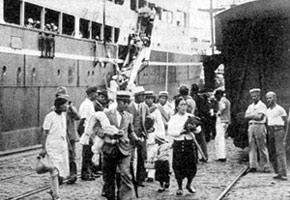
Building materials came from Michigan by ship. The first cargo couldn’t get up the rocky Tapajós until the rainy season, and the first work crew had already revolted over rotting food before construction properly began in 1929. Once it did, the town grew quickly:
- A street grid with American-style clapboard houses
- A hospital, schools, a sawmill and a power plant
- A swimming pool, tennis courts, a golf course, a dance hall and a cinema showing Hollywood films
- A water tower about 50 m tall, also shipped from Michigan, which became the town’s symbol
The town was also divided. The American managers lived in the Vila Americana, which had the best view and, early on, the only running water. The Brazilian workers lived elsewhere and drew water from wells. Grandin compares the layout to “the relationship of suburbia to a city.”
Prohibition, Square Dancing and Watermelons
Ford ran Fordlândia the way his company’s “Sociological Department” had once policed workers in Detroit. Alcohol, tobacco and prostitution were banned, even inside workers’ own homes, and managers went from house to house to check. Workers were expected to keep gardens, eat a Ford-approved diet, and in some accounts attend poetry readings and American folk dances.
The workers found ways around the rules. Riverboats anchored just outside the company’s jurisdiction sold cachaça, sometimes hidden inside watermelons. About 8 km upstream, on what was called the “Island of Innocence,” bars, nightclubs and brothels opened. Many men were also recruited in Belém and Manaus with promises of good wages and then found themselves working through the midday heat on a factory-style timetable. The cafeteria riot of 1930 grew out of all this resentment.
The Real Enemy: Biology
Even if every worker had been happy, the project had a deeper problem. None of Ford’s managers knew tropical agriculture.
In the wild, Hevea brasiliensis trees grow far apart from one another. That spacing protects them from the pests and fungi that evolved with them, especially South American leaf blight. Ford’s engineers planted the trees in neat, close rows, as if they were building an assembly line. The result was an all-you-can-eat buffet for blight, leaf-cutter ants (saúva), lace bugs, red spiders and caterpillars. The Asian plantations worked partly because they were far from the Amazon’s native pests. Fordlândia was planted right in the middle of them.
The town went through several managers in its first few years. Archibald Johnston eventually stabilized it: he paved the roads, finished the housing and improved the schools and clinics. Ford brought in a botanist, James R. Weir, and in the mid-1930s the plantation moved downriver to Belterra, about 40 km south of Santarém, where the land was flatter and better. Fordlândia itself was effectively abandoned as a plantation in 1934.
Synthetic Rubber and a $20 Million Exit
Belterra did better, but not by much, and history overtook it. During the Second World War, the United States developed synthetic rubber on an industrial scale. In 1945, Henry Ford II, who had taken over the company from his ailing grandfather, sold both towns back to the Brazilian government at a loss of more than US$20 million (well over $300 million today).
Two details make the story even stranger. Henry Ford never visited either town. And as NPR summarised Grandin’s research, “not one drop of latex from Fordlândia ever made it into a Ford car.”
Fordlândia Today
The town didn’t completely disappear. From the 1950s to the 1970s, Brazil’s Ministry of Agriculture ran facilities there, and its employees’ families moved into the old workers’ houses. For decades after that, only about 90 people lived there, with medical care arriving by boat now and then. In the late 2000s people began moving back and claiming the empty houses, and by 2017 the district (now part of the municipality of Aveiro) had about 3,000 residents.
Much of Ford’s town still stands: the water tower, the sawmill and kiln, and a three-story workshop now used to store artifacts such as hospital beds and parts of an X-ray machine. The hospital did not survive. Looters stripped it in the late 2000s, and radioactive X-ray material left behind caused a local scare, with people recalling Brazil’s 1987 Goiânia accident until the authorities removed it. Most of the original furniture and silverware in the American houses was carried off or sold.
A Ruin That Became a Metaphor
Fordlândia has found a second life in culture. Icelandic composer Jóhann Jóhannsson named a 2008 album after it. It appears in a 1991 Marsupilami comic, in Michael Palin’s BBC series on Brazil, and in documentaries such as Marcos Colón’s Beyond Fordlândia (2017) and Susana de Sousa Dias’s Fordlandia Malaise (2019).
The town lasts as a metaphor because it captures something bigger than one failed plantation. It shows what happens when a system that worked perfectly in one place is copied, unchanged, into an ecosystem and a culture it doesn’t understand. Ford could standardise a car, but he couldn’t standardise a rubber tree, a riverside community or the Amazon itself.
The town’s own residents may have the last word. A filmmaker quoted by The Guardian said most people there today “don’t care very much about Fordlândia’s history.” For them it is not a ruin or a parable. It is simply home, a small Brazilian town on the Tapajós.
Sources and Further Reading
- Wikipedia, “Fordlândia”: https://en.wikipedia.org/wiki/Fordl%C3%A2ndia
- Drew Reed, “Lost cities #10: Fordlandia – the failure of Henry Ford’s utopian city in the Amazon,” The Guardian, 19 Aug 2016: theguardian.com
- Greg Grandin, Fordlandia: The Rise and Fall of Henry Ford’s Forgotten Jungle City (Metropolitan Books, 2009; ISBN 978-0805082364)
- NPR, “Fordlandia: The Failure Of Ford’s Jungle Utopia,” 6 June 2009: npr.org
- Simon Romero, “Deep in Brazil’s Amazon, Exploring the Ruins of Ford’s Fantasyland,” The New York Times, 20 Feb 2017